
Alaska Property Records
Alaska property records are maintained at the state level through the Alaska Department of Natural Resources Recorder's Office, not by individual counties or boroughs. The DNR oversees 34 recording districts and two physical offices that handle all deed, lien, mortgage, and document filings statewide. You can search Alaska property records online, visit one of the recording offices in Anchorage or Fairbanks, or contact the assessing department in your borough for tax and valuation data. This guide covers how the recording system works, where to find documents, and what to know before accessing property records in Alaska.
Alaska Property Records Overview
How Alaska Property Records Work
Most states keep property records at the county courthouse. Alaska works differently. The state runs a centralized system through the Alaska Department of Natural Resources Recorder's Office. This office oversees all 34 recording districts and holds the official public record for the entire state. Two physical locations handle everything: one in Anchorage at 550 West 7th Avenue, Suite 108, and one in Fairbanks at 3700 Airport Way. These offices process roughly 1,000 new documents each day and have built an archive that dates back to before statehood. Millions of documents now sit in this system. Knowing how the DNR recording structure works is the starting point when you need to find, verify, or record any property document in Alaska.
The recording system uses two main indexes. The first is an alphabetical grantor and grantee index. When a deed is filed, both the current owner (grantor) and the new owner (grantee) are indexed by name. This lets you search by person or company to find all documents tied to that party. The second index is based on legal description and location. You search by section, township, range, and meridian to pull records for a specific parcel. Both indexes cover documents recorded from 1970 to the present. Records before 1970 exist in historic books but require a more involved search process. Staff at both offices can point you in the right direction for older filings, though they are not set up to conduct extensive historical research on your behalf. The online system handles current documents quickly. Older records may take more legwork to locate.
Alaska uses a race-notice recording statute. The first buyer who records a deed and has no prior notice of an unrecorded claim wins priority. Recording your deed promptly matters under Alaska law.
The Alaska DNR Recorder's Office provides a secure, accessible place to record and preserve the permanent public record of Alaska as directed by state statutes. All official records are public and may be viewed or copied by anyone who requests them.
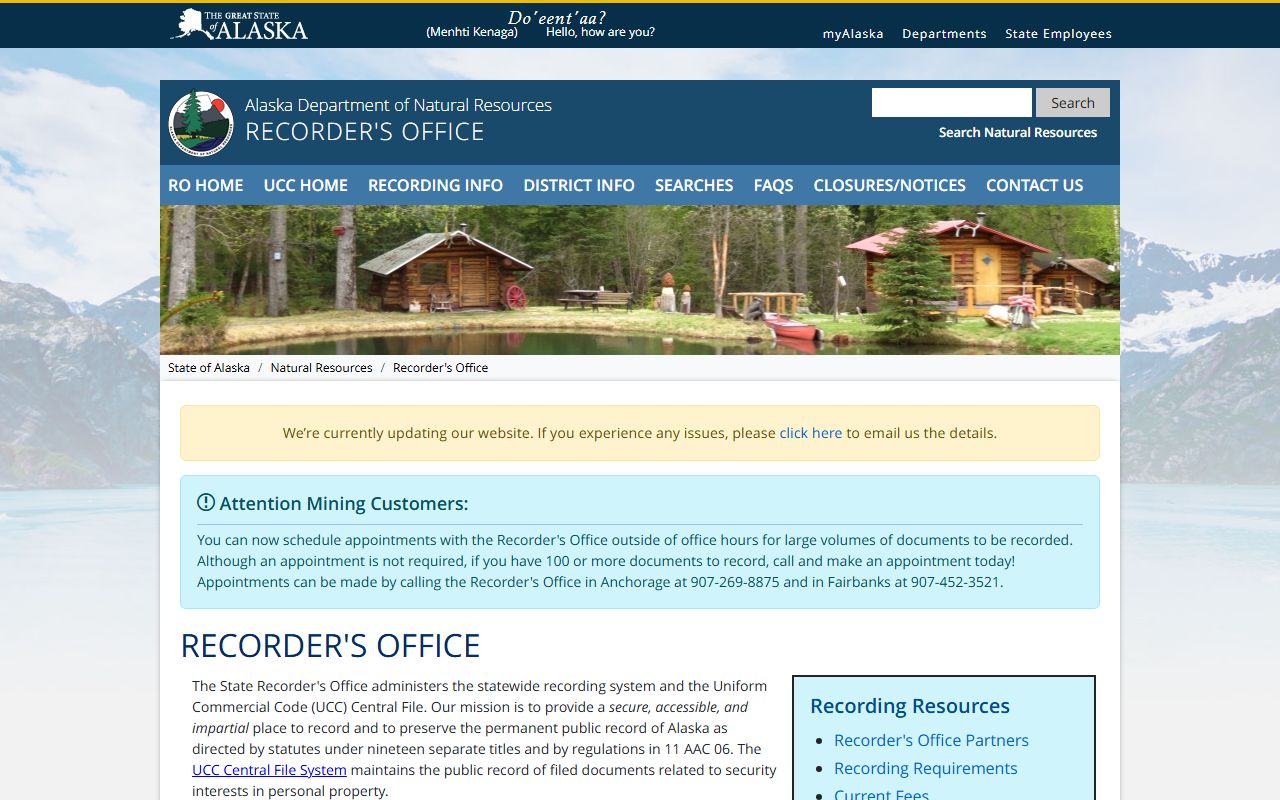
Both the Anchorage and Fairbanks offices accept walk-in recording during regular business hours and can assist with in-person searches of Alaska property records.
Search Alaska Property Records Online
The DNR runs an online land records portal at dnr.alaska.gov/landrecords. This system lets you locate, research, and verify ownership, land use, and authorizations on state-managed property. You can search by file type and file number, customer name, or legal description using a long or shorthand section-township-range-meridian designation. The portal also connects to the federal Bureau of Land Management case retrieval system (ACRES), master title plats, and federal survey records. No account is needed to browse basic records, though downloading images may require free registration. This portal is especially useful for Alaska parcels carved from state or federal land, which covers most privately held property in the state.
For recorded deeds, mortgages, and liens on private property, the DNR recording database is the right tool. Records are indexed by grantor and grantee name, document type, date, and serial number. To search effectively, you need the full name of one party or the document's book and page number or serial number. The database runs from 1970 forward and updates daily as new filings come in. Once you locate a document in the index, you can view it online and print a copy from the site or at one of the two offices. Copy fees apply for printed pages.
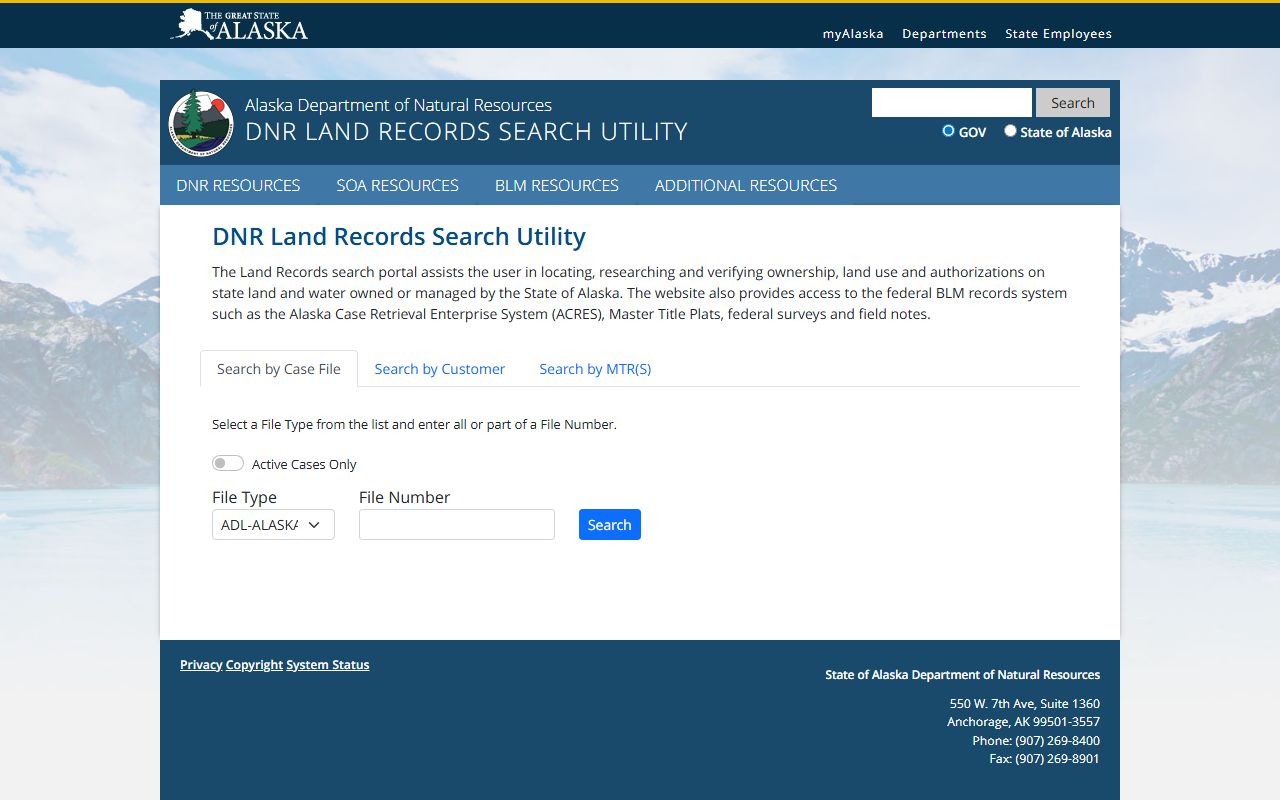
The DNR land records system links to Alaska Mapper and federal BLM survey download tools for users who need visual parcel data or historic plat maps alongside recorded document searches.
Alaska Mapper and Interactive Property Tools
Alaska Mapper gives you a visual approach to property research. The interactive map displays state-managed land and lets you query ownership, land use, and authorizations geographically. You can zoom into a specific area, click on parcels, and view legal description and land status information tied to each parcel. This is helpful when you know roughly where a property sits but don't have an exact parcel number or legal description to start with. Keep in mind the map is for graphic reference only. Recorded documents at the Recorder's Office remain the official record. Alaska Mapper was updated in 2024 with new base maps, ArcGIS imagery layers, and updated mining claim research maps. DNR Public Information Centers in Anchorage, Fairbanks, and Juneau can assist with hands-on mapping research for complex projects.
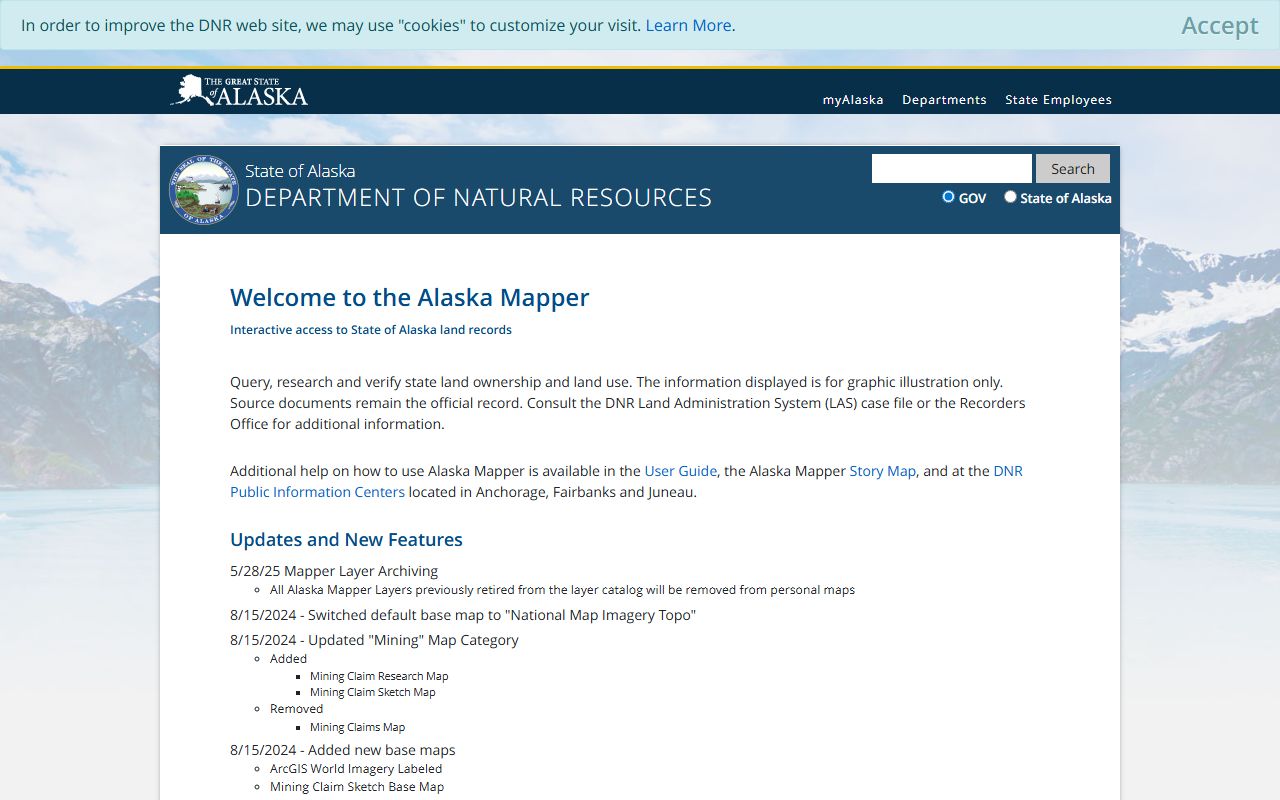
Alaska Mapper layers include state land ownership, mining claims, survey boundaries, and high-resolution imagery that users can view and combine for property research purposes.
Types of Alaska Property Records
The Alaska recording system holds a wide range of real estate documents. Deeds are the most commonly searched. Warranty deeds and quitclaim deeds transfer ownership from one party to another. Mortgages and deeds of trust secure loans against real property. Assignments change who holds a mortgage or lien interest. Modifications update the terms of a recorded instrument. Reconveyances release a deed of trust once a loan is paid in full. Together, these documents form the chain of title for every parcel in Alaska, documenting every owner and every lien from the first recorded instrument to the present day.
The system also holds liens and encumbrances of many kinds. Mechanics and materialmen liens give contractors and suppliers a claim against property when payment is not made for work or materials. Federal and state tax liens attach to real property when someone owes back taxes to the government. Child support enforcement liens can be recorded against real estate. Judgment liens from court orders attach to all property a debtor owns in the district where the judgment is filed. When these obligations are satisfied, a release or satisfaction document gets filed to clear the record. UCC fixture filing statements cover personal property that has become physically attached to real estate, such as built-in equipment or fixtures. Each document that comes in gets stamped with a date, time, and serial number. Staff then index the grantor and grantee names and legal description exactly as they appear on the document, making the record searchable later.
All records are public. Anyone can request copies. No reason is required. Fees are set by statute and apply equally to everyone.
Alaska Property Recording Fees
The DNR recording fee schedule is set by Alaska statute under AS 40.17.030(a)(10) and 11 AAC 05.200. Recording any document costs $20.00 for the first page or fraction thereof. Each additional page of the same instrument adds $5.00 more. If more than six names need to be indexed, there is a $2.00 charge per extra name. Documents that do not meet the standard margin or paper requirements can still be accepted by paying a $50.00 non-standard document fee in addition to the regular recording fee. Plats and surveys carry the same base rate of $20.00 for the first sheet and $5.00 for each additional sheet. Getting a certified copy of any recorded document costs $5.00. Alaska charges no real estate transfer tax, which means the recording fee is often the only direct government cost when property changes hands.
Copy fees are separate from the recording fee. A conformed copy made at the time of recording costs $2.00. After recording, plain paper copies run $1.25 for the first page and $0.25 for each additional page of the same document. Plat copies on paper cost $5.00 per sheet, while mylar copies cost $12.00 per sheet. Make checks payable to the Department of Natural Resources when paying in person.
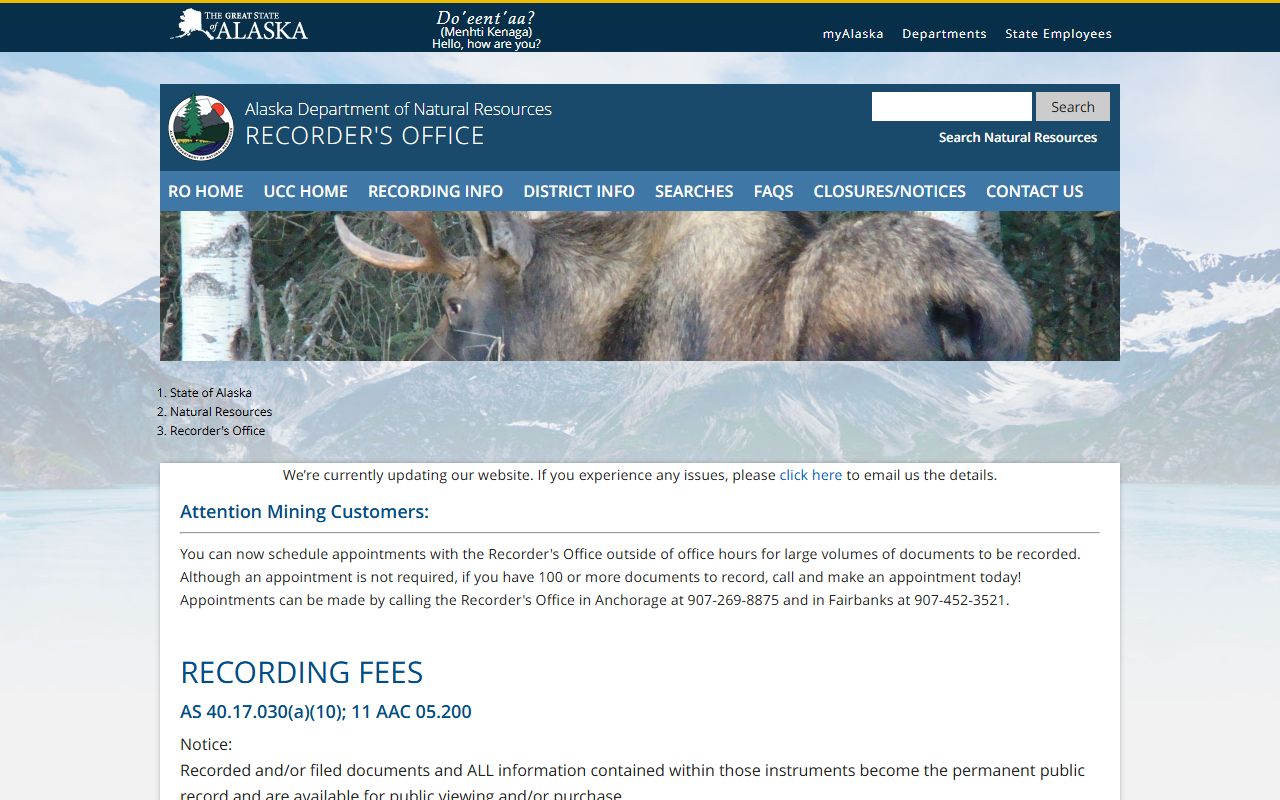
The full DNR fee schedule is posted at both recording offices and available online at the DNR fees page before you file.
Preparing Alaska Property Documents for Recording
Before submitting a document to the Alaska DNR Recorder's Office, it must meet specific formatting rules set by AS 40.17.030(d) and 11 AAC 06.040. Documents must be on opaque white paper no larger than 8.5 by 14 inches. The first page needs a two-inch top margin so recording staff can stamp the filing information there. All other sides and all subsequent pages require one-inch margins. Type must be at least 10-point font and must be clear enough for the scanning camera to read. Broken characters or uneven ink density will cause problems at the desk. Documents that cannot meet the margin rules can still be accepted by paying the $50.00 non-standard fee in addition to the standard recording fee.
Every Alaska deed must clearly state the recording district by name, not just the borough or county. It must include complete mailing addresses for all parties who grant or receive an interest. A return name and full mailing address with zip code must appear on the document so the recorder knows where to send it after filing. If the document amends, corrects, modifies, or releases a prior recorded instrument, it must reference that instrument's book and page number or serial number. Conveyances, powers of attorney, and real property contracts must be signed by the grantor and acknowledged before a notary public or other officer authorized to take acknowledgments in Alaska.
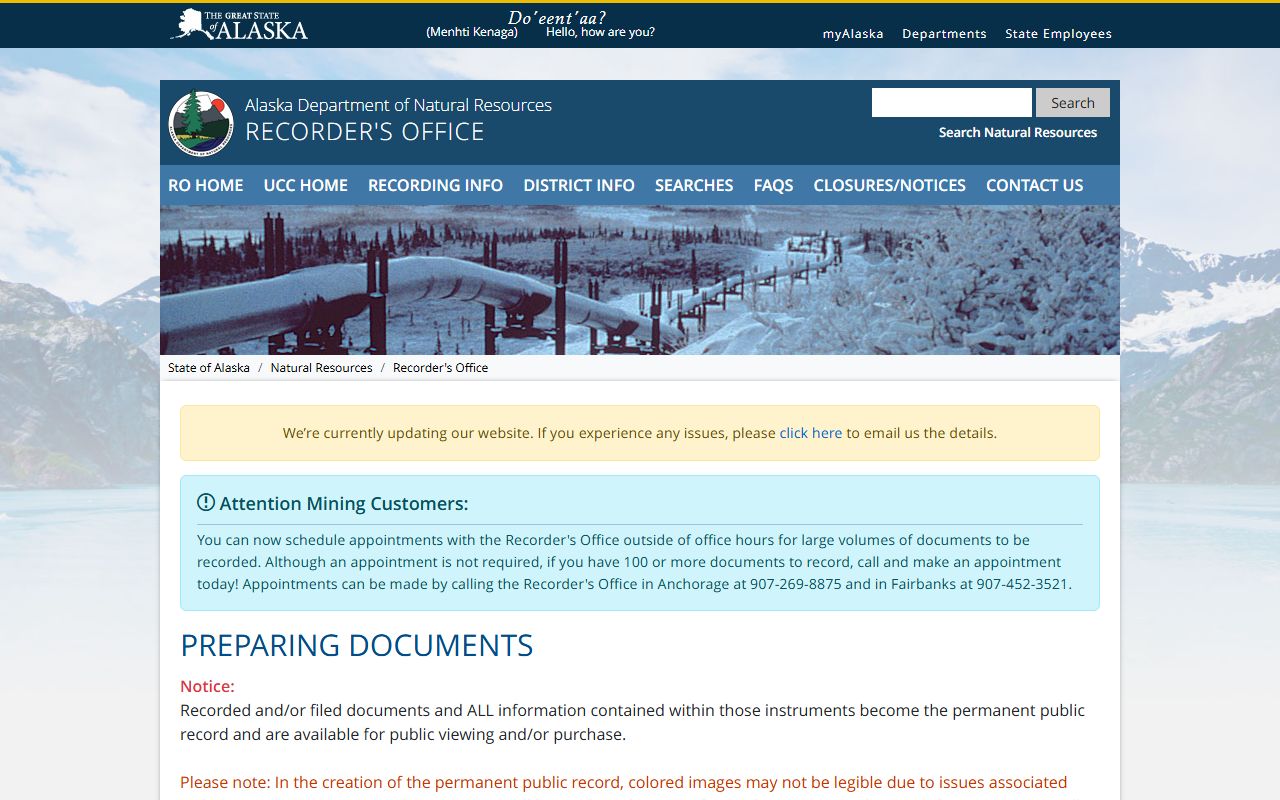
Preparing documents correctly before arriving at the recording desk avoids the non-standard fee and prevents delays in getting your Alaska property document into the official record.
Alaska Recording District Offices
All 34 of Alaska's recording districts route through just two physical offices. The Anchorage Recording District office at 550 West 7th Avenue, Suite 108, Anchorage, AK 99501-3564, phone (907) 269-8876, handles southern and coastal Alaska. Districts served from Anchorage include Aleutian Islands, Anchorage, Bristol Bay, Chitina, Cordova, Haines, Homer, Iliamna, Juneau, Kenai, Ketchikan, Kodiak, Kvichak, Palmer, Petersburg, Seldovia, Seward, Sitka, Skagway, Talkeetna, Valdez, and Wrangell. State Recorder Chrissi Thurman is based at this office and can be reached at (907) 269-8882.
Interior and western Alaska recording districts go through the Fairbanks office at 3700 Airport Way, Fairbanks, AK 99709-4699, phone (907) 452-3521. Districts handled from Fairbanks include Barrow, Bethel, Cape Nome, Fairbanks, Fort Gibbon, Kotzebue, Kuskokwim, Manley Hot Springs, Mt. McKinley, Nenana, Nulato, and Rampart. A UCC Central File operates from Suite 108A at the Anchorage address and maintains the statewide Uniform Commercial Code filing library separately from deed and lien records. If you need to record 100 or more documents at one time, appointments outside normal walk-in hours are available. Call Anchorage at (907) 269-8875 or Fairbanks at (907) 452-3521 to schedule.
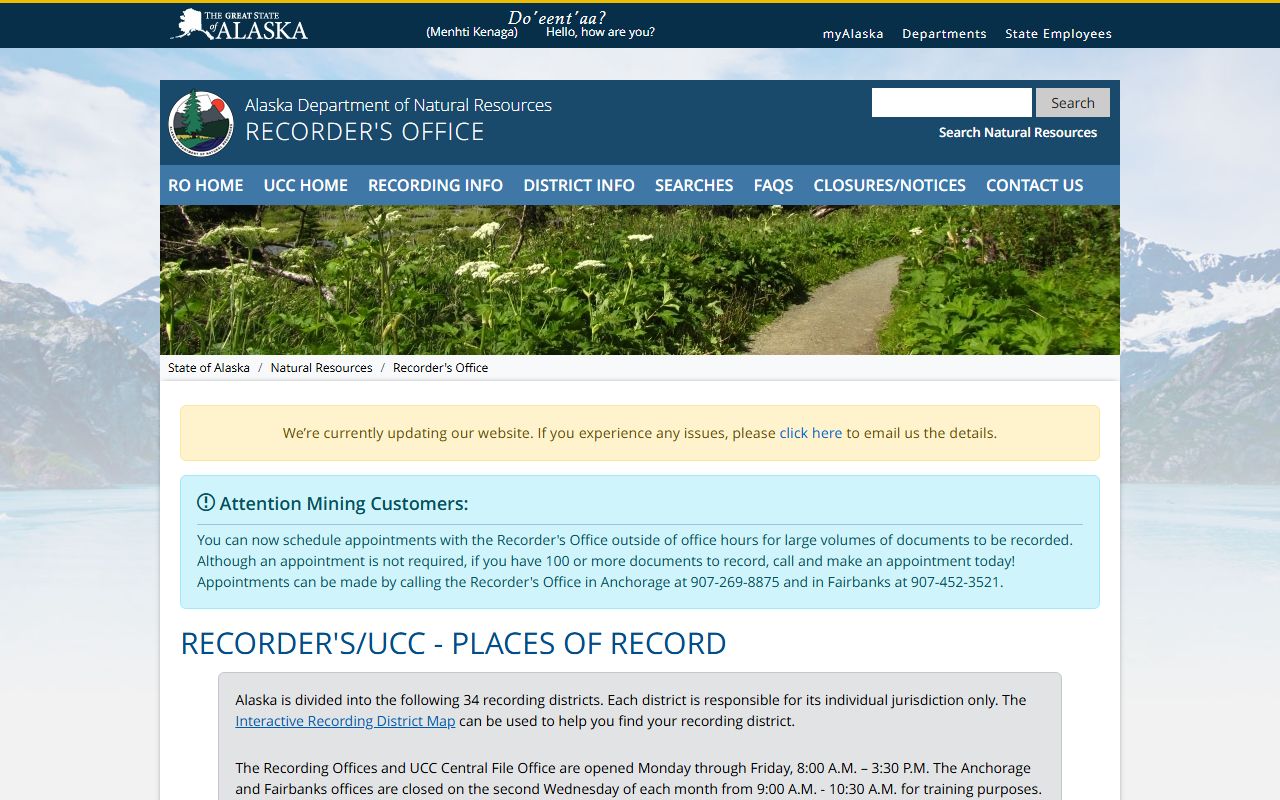
The DNR district list at dnr.alaska.gov/ssd/recoff/distlist details which of Alaska's 34 recording districts each office serves along with key personnel contacts.
Electronic Recording for Alaska Property Documents
Alaska accepts electronic recording through three approved providers: Simplifile, CSC, and ePN (eRecording Partners Network). The Alaska e-Recording program lets authorized submitters file documents directly from their offices without mailing or hand-delivering paper to Anchorage or Fairbanks. Each provider charges its own annual and per-document fees on top of the standard state recording fees. Simplifile can be reached at (800) 460-5657 Ext. 1034 or at simplifile.com. CSC eRecording support is at (866) 652-0111. The ePN network can be contacted at (818) 294-3694. These services are set up primarily for title companies, lenders, and other high-volume filers rather than individual property owners. Most title companies in Alaska are authorized submitters and can file documents on your behalf electronically for an additional service fee.
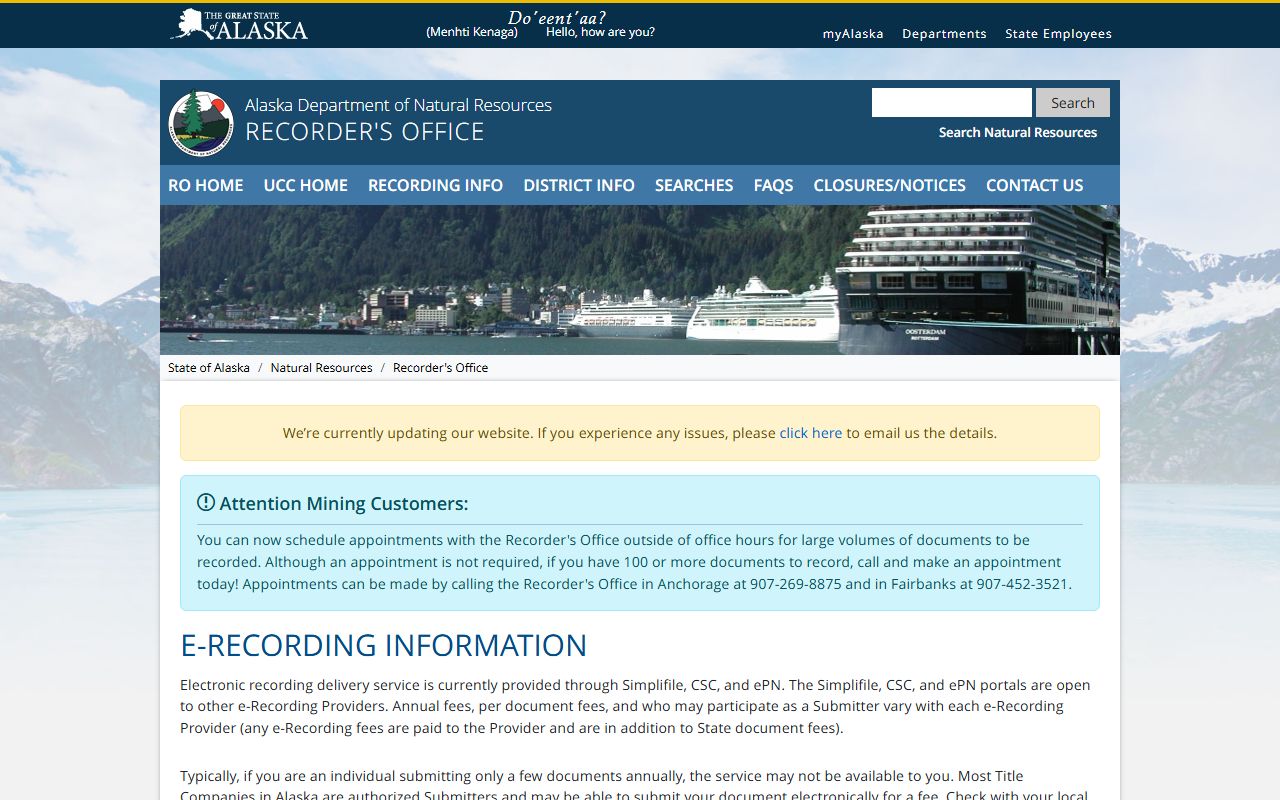
E-recording provider fees are paid directly to the provider and are separate from the state DNR recording fees, which still apply for every document submitted.
Alaska Native Land and ANCSA Property Records
Property research in Alaska often runs into land that is neither privately owned nor simple state or federal territory. The Alaska Native Claims Settlement Act of 1971 conveyed roughly 45 million acres to more than 200 Alaska Native corporations. ANCSA created split estates. Village corporations typically own the surface rights to land while regional corporations hold the subsurface rights. That means if you buy property that borders or touches ANCSA land, the entity that controls what is underground may differ from the one that controls the surface. Understanding which party holds which rights matters for anything from construction to resource use. The split-estate structure also affects title research because surface and subsurface rights can each carry separate recorded histories in different record systems.
Section 17(b) of ANCSA reserved public access easements across Native corporation land. These easements allow trail, road, and waterway access to reach public lands beyond. They are recorded encumbrances that travel with the land. If you are buying property near or adjoining ANCSA land, you may find one or more 17(b) easements attached to the parcel. These are not always obvious in a basic index search, which is one reason professional title work matters in Alaska. More than 60 percent of Alaska's total land area is federal territory managed by BLM, the National Park Service, the U.S. Fish and Wildlife Service, and the Forest Service. Another 45 million acres went to Alaska Native corporations under ANCSA. Less than one percent of Alaska's land is privately held by individuals.
The Bureau of Indian Affairs Alaska Land Titles and Records Office is the official federal record for title documents on Alaska Native and Indian land. The LTRO records, examines, and certifies the status of title for all Indian trust and restricted lands in Alaska. Contact them at (907) 271-4593.
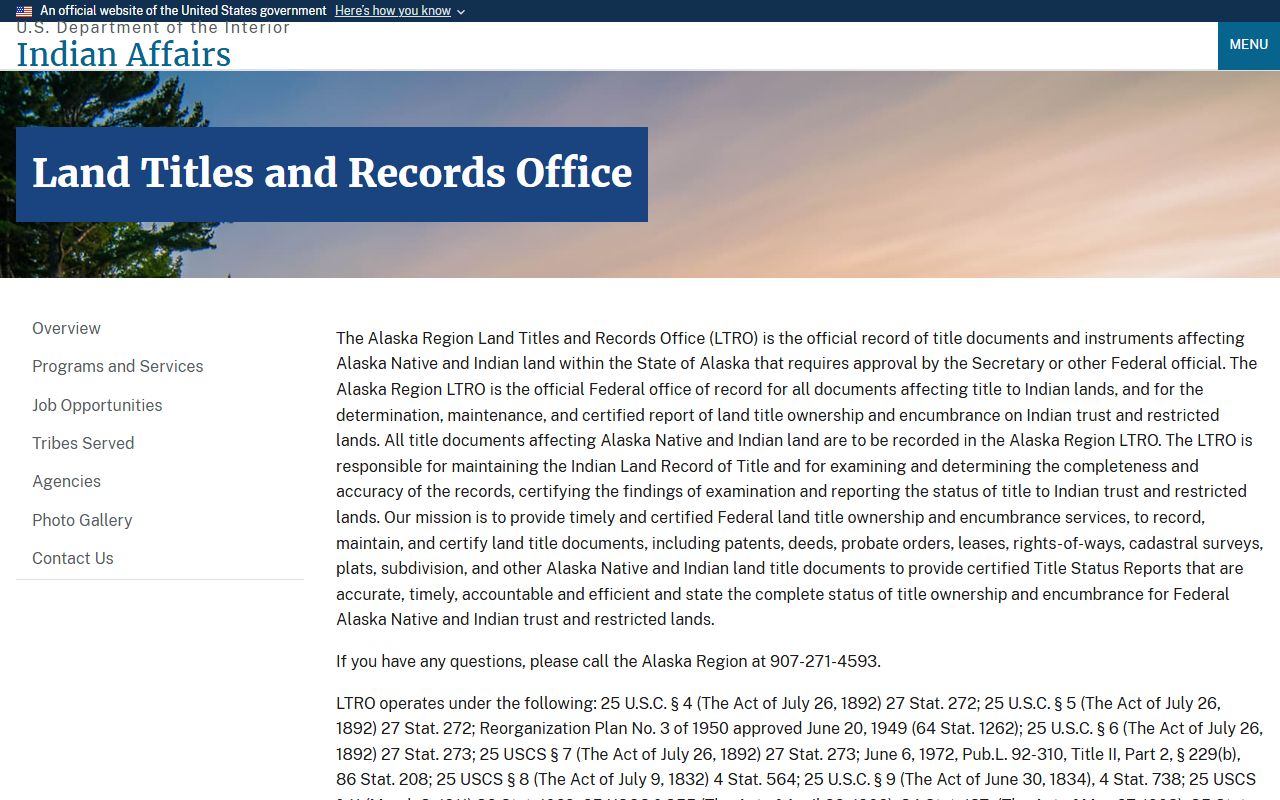
The BIA LTRO provides certified Title Status Reports for federal trust and restricted lands, which are maintained in a system separate from the DNR recording database used for private property transactions.
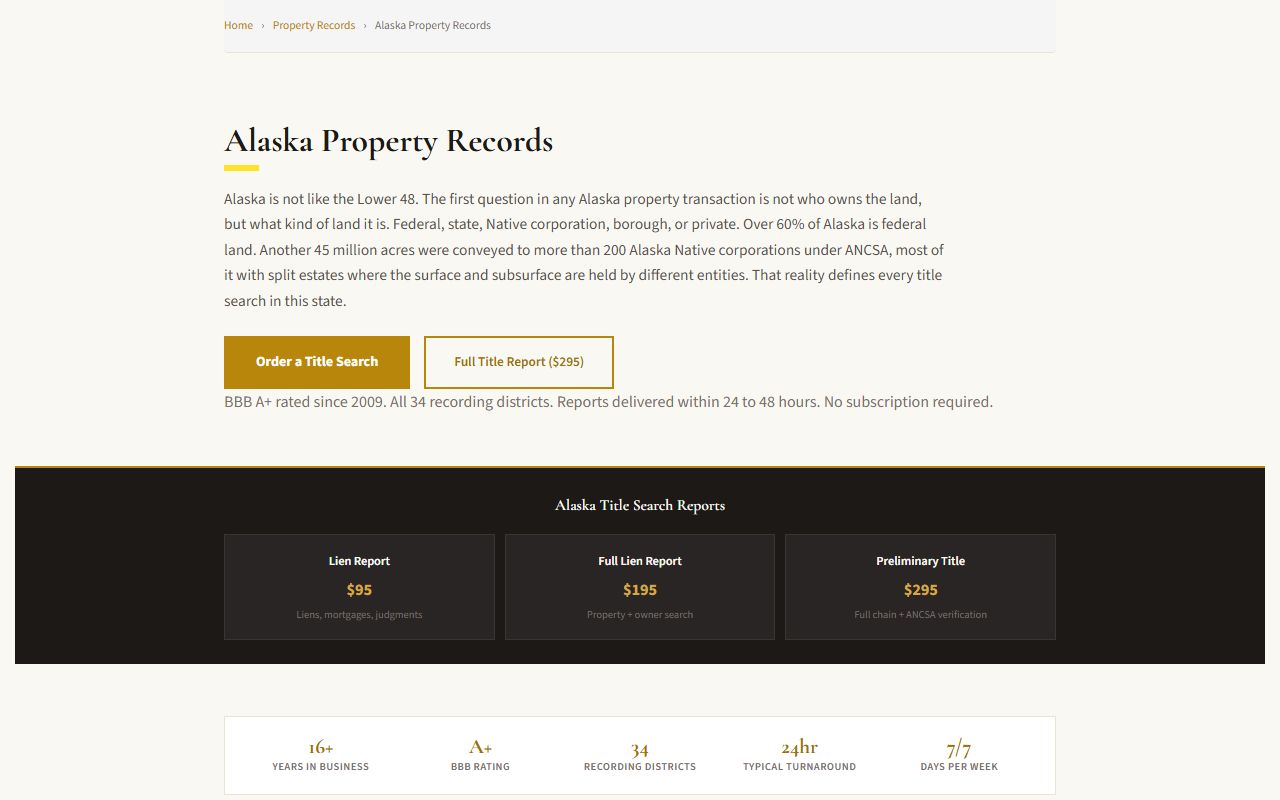
Understanding ANCSA land structure, split estates, and 17(b) easements is an essential part of any thorough Alaska property title review, especially for parcels near Native corporation boundaries.
Alaska Property Recording Laws and Statutes
Alaska property recording is governed by Alaska Statutes Title 40, Chapter 17. This chapter defines where documents must be recorded, what they must contain, and what legal effect recording has. Under AS 40.17.010, any document affecting real property title must be recorded in the district where the property is located. AS 40.17.020 requires conveyances to be recorded to give constructive notice to subsequent purchasers. AS 40.17.060 states that properly recorded documents serve as constructive notice to all later buyers and lenders. This is the foundation of the race-notice doctrine that Alaska follows. Under AS 40.17.050, the date and time of recording determines priority between competing claims to the same property.
AS 40.17.030 sets out the specific formatting and content requirements for documents accepted for recording. These include original signatures, legible text, proper margins, complete legal descriptions, the recording district name, and full mailing addresses for all parties. Under AS 40.17.035, the recorder reviews documents only for format compliance. The recorder cannot refuse a document simply because its contents may not be legally sufficient to affect title. If the form rules are met and fees are paid, the document will be recorded. This procedural role is why working with a title professional matters for any significant property transaction in Alaska. AS 40.17.080 defines the boundaries of Alaska's 34 recording districts.
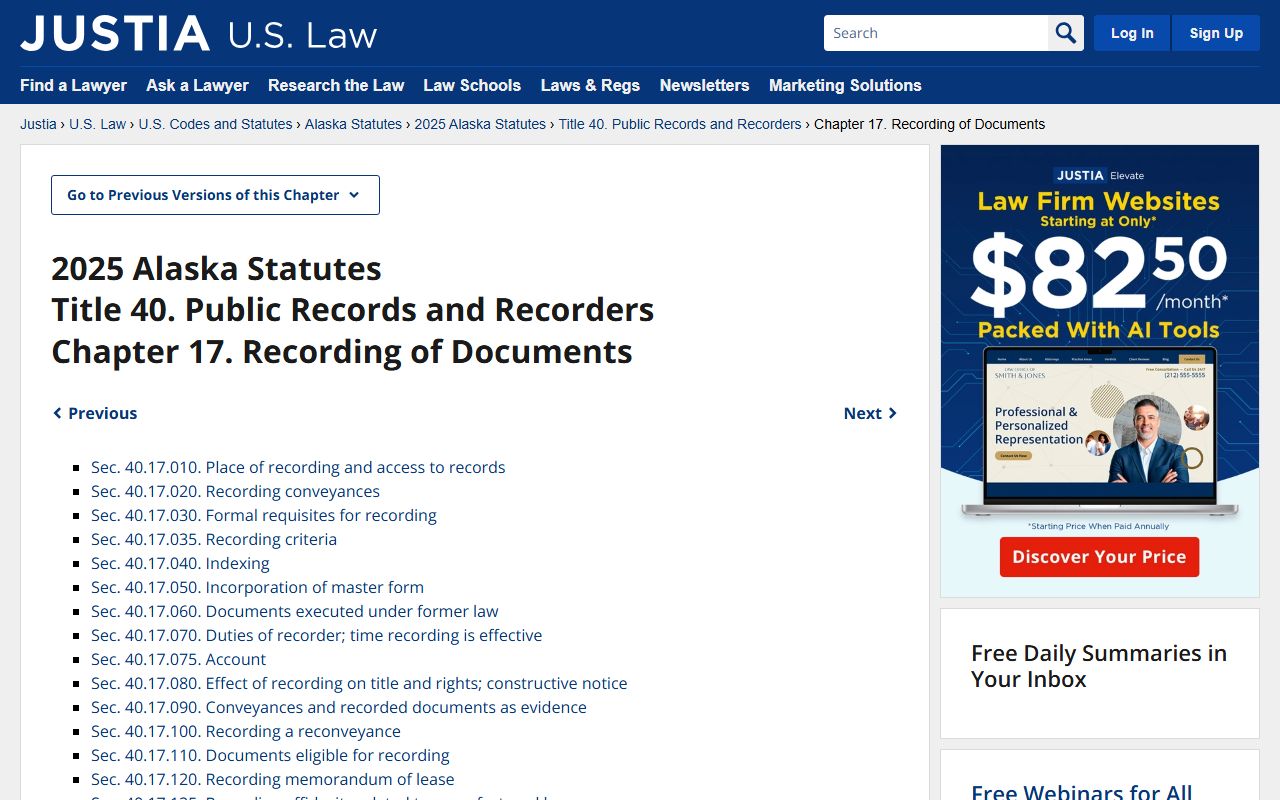
Alaska Statutes Title 40, Chapter 17 is searchable through Justia's statutes database and through the official Alaska Legislature website for free public access.
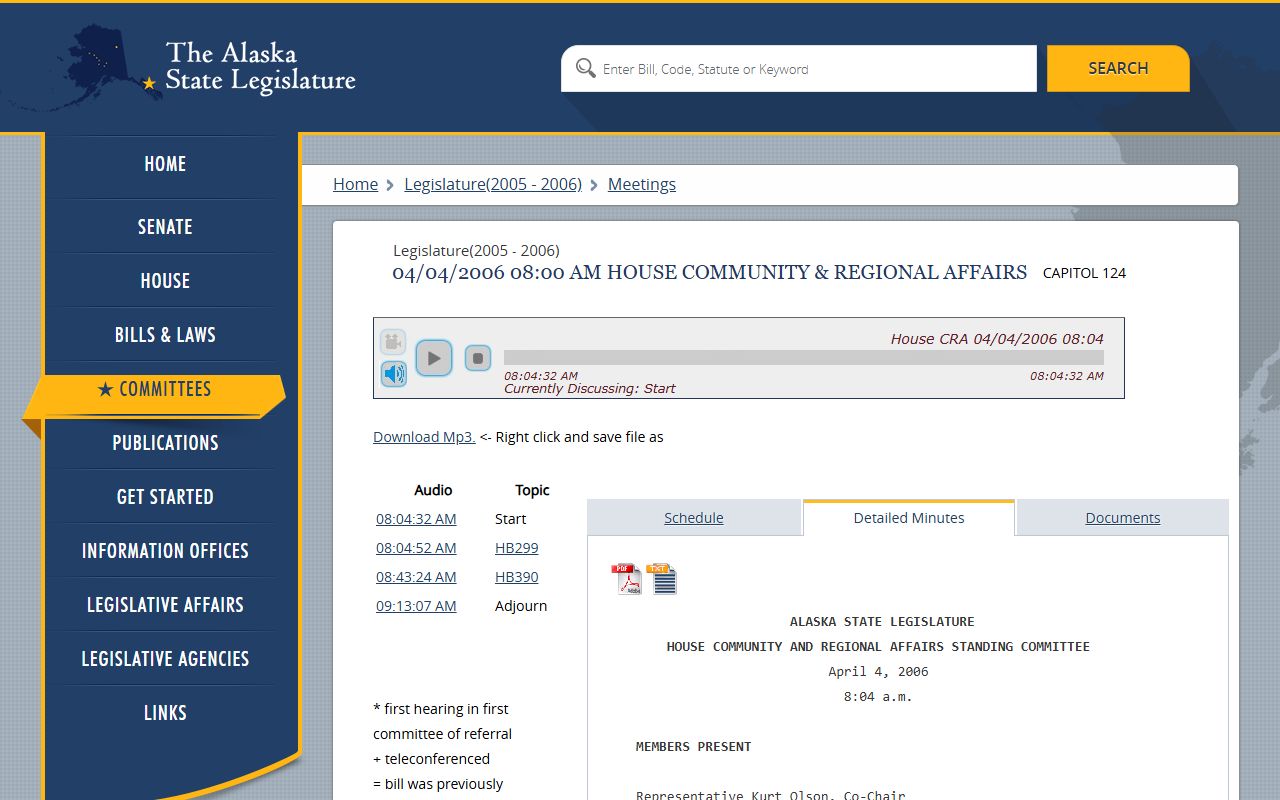
The Alaska State Legislature has reviewed property assessment appeal fees, with testimony showing boroughs like Anchorage, Kenai, and Ketchikan charge fees for assessment appeals that are refunded when the board makes a change in assessed value.
Property Tax and Assessment in Alaska
Alaska has no statewide property tax. Property taxes are levied by organized boroughs, not the state government. Each organized borough sets its own mill rate and assesses all taxable real property within its boundaries in accordance with Alaska law. Unorganized census areas either have no local property tax or rely on state-level functions for any assessment that applies. The Alaska homestead exemption is $72,900. Effective tax rates vary widely across boroughs. Anchorage Municipality and Fairbanks North Star Borough both run around 1.17 percent. Rural organized boroughs often carry lower rates. Most boroughs with organized assessing departments offer online property search tools where you can look up assessed values by parcel number, owner name, or address. Contact your borough's assessing department for local mill rates, payment schedules, exemption programs, and appeal deadlines.
Borough assessing departments handle property valuations, senior and veteran exemption programs, and the formal appeal process through local Boards of Equalization in each organized area of Alaska.
Alaska Deed Requirements and Foreclosure
Alaska deeds must be on white paper no larger than 8.5 by 14 inches with a two-inch top margin on the first page and one-inch margins elsewhere. The grantor must sign in the presence of and before acknowledgment by a notary public, a judge or court clerk, or a commissioner of deeds. The deed must name the recording district, include a complete legal description sufficient to identify and locate the parcel, and list full mailing addresses for all parties. A return address with zip code must appear on the document. Alaska does not charge a real estate transfer tax. Alaska is a deed-of-trust state that allows non-judicial foreclosure. A trustee can complete a foreclosure by public sale after required notice, with the process taking roughly 120 days. There is no statutory redemption period after a non-judicial sale is finalized. Judicial foreclosure is also available and carries a one-year redemption period.
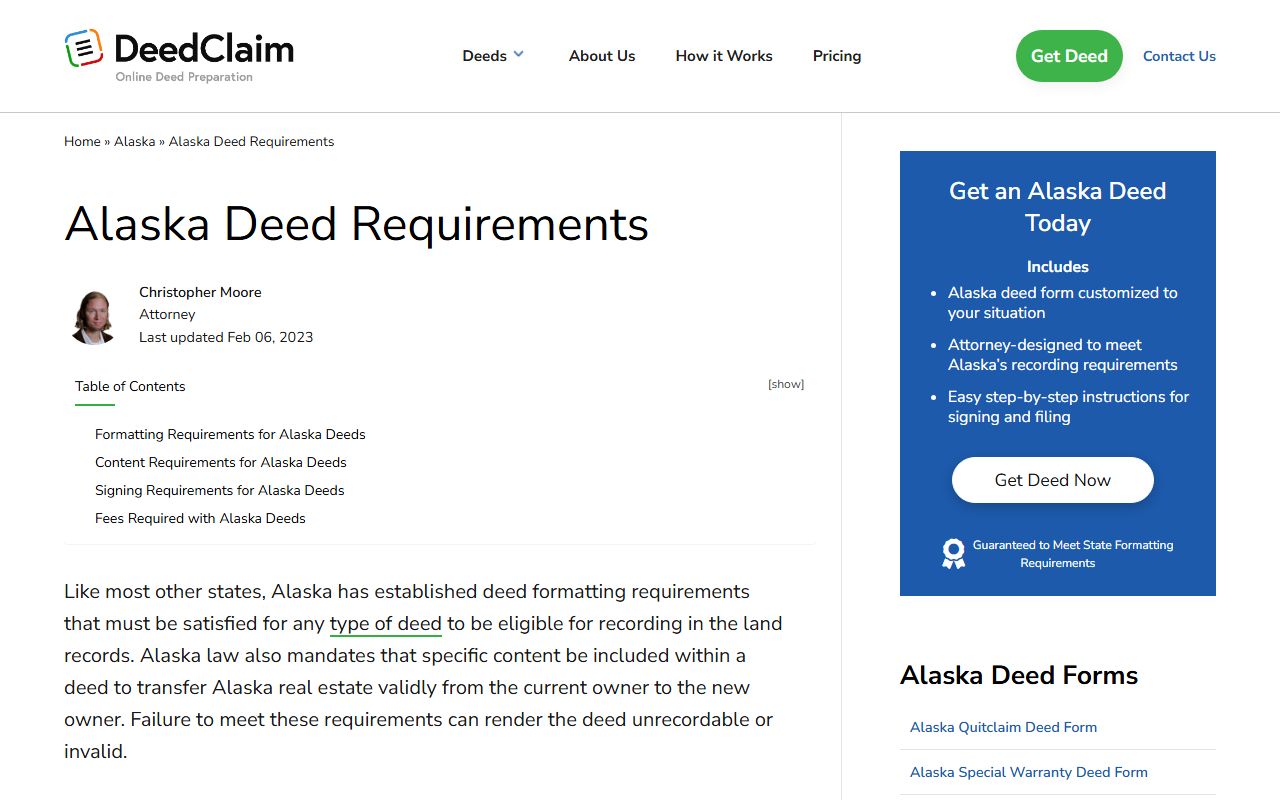
Deed signing and formatting requirements are set by AS 40.17.030 and apply to all instruments submitted to the DNR Recorder's Office for recording in any of Alaska's 34 recording districts.
Browse Alaska Property Records by Location
Alaska property records are organized by recording district, but most people search by borough or city. Select an area below to find local office contacts, assessing department information, and online search tools for property records in that part of Alaska.
Alaska Borough and Census Area Property Records
Alaska's organized boroughs each maintain assessing departments for property tax records. Deed and lien recording for all boroughs flows through the DNR Recorder's Office in Anchorage or Fairbanks depending on the borough's recording district assignment.
View All 30 Alaska Boroughs and Census Areas
Property Records in Major Alaska Cities
Cities in Alaska file property documents through the DNR recording district that covers their area. For assessed values and property tax data, contact the borough assessing department where the city sits.